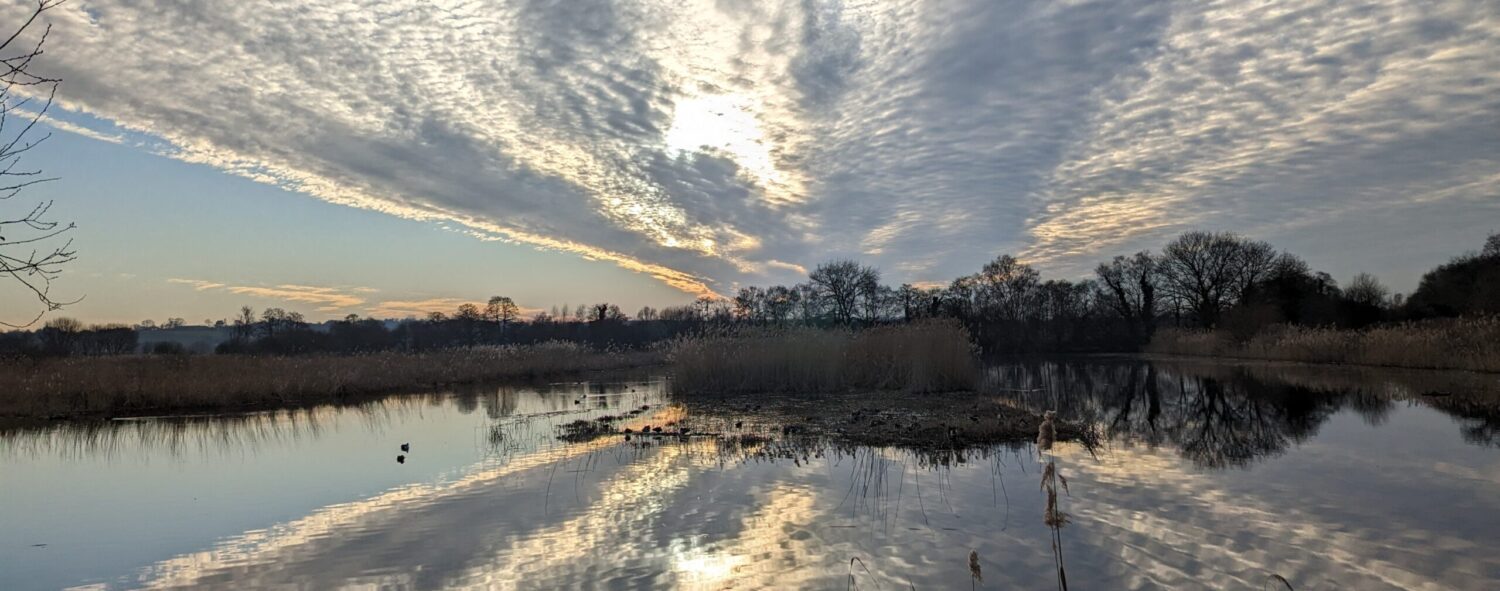
Tice’s Meadow 28 April 2025

Ten assembled in Aldershot Park on a fine morning that promised the start of a warm spell. Wrens and Blackcaps were in good voice around the car park while a pair of guttural Egyptian Geese was half concealed behind swings. Two Swifts were spotted high in the sky and very distant, their shape barely discernible. Close to the river the first of many Chiffchaffs was heard; later a couple gave good views. A Green Woodpecker yaffled loudly and was soon after seen crossing the path. By now Blackbirds and Robins were contributing to the morning chorus though Wrens and Blackcaps still predominated. Soon a Garden Warbler could be heard buried deep in the bushes and a couple of House Martins were glimpsed between trees. Closer to the pits two Whitethroats were singing while a Reed Warbler could could be just about discerned.

From the mound it was apparent that the water was very high with its main occupants many dozens of Coots interspersed with six Great Crested Grebes, a scattering of Moorhens and only four Tufted Ducks, the sole waterfowl present. Around the banks, notable were a Grey Heron and a Wheatear that irritatingly refused to stay in sight for proper viewing. Overhead was more interesting fare. Two Peregrines circled distantly, two Buzzards and three Red Kites were picked out above the hill and a Sparrowhawk obliged with a close flyover. Then three Swifts passed above and two Swallows briefly appeared. In front of the mound two Whitethroats provided entertainment by perching close by. Finally three Common Terns flew in and eventually perched on distant posts.

The return walk was notable for emerging butterflies with Brimstone, Peacock, Speckled Wood, Orange Tip, Red Admiral and Small Tortoiseshell all seen. Another Garden Warbler made its presence felt but stubbornly failed to reveal itself. The feeding area provided some new sightings such as Dunnock, Long-tailed Tit and Collared Dove. The star of the final stretch was a concealed male Bullfinch that a few were fortunate to glimpse. The species list for the excellent walk totalled 49.

Frensham Little Pond 17 April 2025

A sunny morning with light winds brought 19 members to Frensham Little Pond looking for spring migrants. Blackcap and Chiffchaff were singing throughout the walk and showed occasionally. They were often accompanied in song by a plethora of more common woodland birds. The lake held the usual suspects – Greylag Geese, Canada Geese, Coots, Cormorants, a few Tufted Ducks and Mallard. A pair of Great Crested Grebes were displaying and a Kingfisher flashed back and forth across the water, pausing briefly in a bush to subdue a fish it had caught. Two Treecreepers showed well, but the Reed Warbler muttering in the corner reed bed stayed hidden. Two Grey Herons were seen and a few Black-Headed Gulls were occupying the tern rafts. A Buzzard flew overhead mewing.

Out on the heath it was quieter, perhaps because birds were already nesting, but Stonechat and Woodlark were seen, Willow Warbler, a Common Redstart and a Tree Pipit heard and a singing Dartford Warbler was eventually spotted by a few tall members!

Back at the lake Cetti’s Warbler called and two more obliging Reed Warblers chased to and fro in the reeds, challenging the photographers. As a grand finale, two Common Terns appeared, dipping over the water. An enjoyable morning with over forty species seen/heard.

Oare Marshes 12 April 2025

Nine members found hazy sunshine and a cool breeze blowing from the sea at this excellent reserve. The fun began in the car park with a couple of Sedge Warblers settling into their summer quarters with raucous song and flight display; they proved to be all around the East Flood with a count of fifteen. Cetti’s Warblers and Linnets were also very vocal. From the sea wall a few waders could be seen, Redshanks, Curlews and an Oystercatcher plus a few Shelducks. An appreciable number of Mediterranean Gulls were wheeling around and mewing while at the edge of The Swale a Common Tern was patrolling. Further out the water was quiet with just a Great Crested Grebe in view but a dozen or so seals were hauled up on the opposite side.

The initial stages of the walk were uneventful with an occasional Reed Bunting and Stonechat leavening the diet of Sedge Warblers. A couple of Common Buzzards became the first raptors of the day but it was not until the East Flood came into view that the action started. There the first impression was of hundreds of Black-tailed Godwits, the great majority in handsome breeding plumage, spread all over. Among them were many Redshanks and a few dozen Avocets sweeping the flood. Waterfowl were represented mainly by Teal with the odd Shoveler, Mallard, Gadwall, Greylag and Mute Swan. Careful scanning revealed two Green Sandpipers and a Ruff among the waders. At this point panic broke out among the flocks typical of the reaction that a Peregrine produces but on this occasion the culprit was a White-tailed Eagle passing right overhead, its “barn door” wings seeming to darken the sky, an exhilarating moment. A Red Kite was near it and its size appeared diminutive in comparison.

Then it was on to the hide for lunch and more leisurely observation. Some Turnstones were roosting on a distant bank; a Common Snipe was winkled out from a small tussock; and then two Greenshanks flew in and gave close views. It remained however the ubiquitous Black-tailed Godwits that continue to catch the eye in their burnished plumage. On the final stage of the circuit a few of the commoner birds finally gave themselves up, Great Tit, Dunnock and Robin followed shortly by a Moorhen and then a single Lapwing. On the West Flood a few Little Egrets and Grey Herons were sighted and then a fine male Marsh Harrier appeared on patrol over the reeds. The walk concluded in a now bitter wind with a look at the ditches on the west side which unusually was extensively under water. There the final sighting of the day was a pair of Little Grebes bringing the species list to a satisfying 62.

Horsell Common 20 March 2025

23 people met at Heather Farm on 20th March, the first day of astronomical spring and fittingly the warmest day of spring so far. 

We set off along the river meadows of the Heather Farm ‘SANG’ following the river Bourne. Pleasingly 3 or 4 pairs of lapwings were displaying in the damp fields opposite the carpark, hopefully settling to breed for a third consecutive year. The further fields held Egyptian, Canada and Greylag Geese together with Mallards and a pair of distant Mandarins. Several circling Red Kites and a couple of Buzzards were above, with a single perched Kestrel

We saw and/or heard a good selection of resident passerines in the bordering hedgerows and trees. In addition small groups of Redwings were still present. Of the summer migrants the Chiff Chaffs had arrived in force, and a single Blackcap was heard.

On the heathland Stonechats were displaying and a few Dartford Warblers were seen by most of the group, together with several pairs of Long-tailed Tits in the birches. A detour onto the McLaren fields gave us singing Skylarks and parachuting Meadow Pipits, and as we headed back to the heathland via the pine woods the highlight of the walk had to be excellent views of two Firecrests showing in close quarters in the sunlight.

Little Grebe, Coots, Cormorants and a Moorhen on the wetland brought the morning’s total to 55 species.

Titchfield Haven 16 March 2025

Fifteen members assembled at the sailing club in brilliant sun. We first scanned the Solent and found four Eiders offshore while along the tideline were numerous Sanderlings scurrying around near some Ringed Plovers. A Red-throated Diver flew west. Several Brent Geese and a surprising number of Gadwall were on the sea while the perched gull flock included a dozen Mediterranean Gulls, two Common and a Lesser Black-backed Gull. Passing the harbour en route to the visitors’ centre we saw sixty or more Turnstones crowding the diminishing mud with some on the pavement only a few feet from us.

Starting along the path on the east side of the reserve we passed feeders and caused two Jays to flee while a Reed Bunting and a Dunnock remained in sight. A little further on we reached the point where we hoped to find a Tawny Owl. Despite a local volunteer pointing out precisely where it was roosting it remained invisible among the ivy to all but one fortunate member who caught a glimpse of it. Meanwhile birdsong was our constant companion including from Chiffchaffs, Greenfinches, Chaffinches, Robins and Wrens. Before we reached the Meadow and Knights Bank hides a Grey Wagtail briefly appeared. From the hides a fair array of birds could be seen. A couple each of Curlews and Lapwings and small flocks of Canada and Greylag Geese shared the grass with some Highland Cattle. On the water were some Mute Swans and a variety of ducks including Shelducks, Shovelers and Tufted Ducks. Cormorants were perched on fences as was a female Stonechat. Marsh Harriers were repeatedly seen reaching four in number at one point.

After a sandwich lunch by the sea during which the loss of the cafe was lamented we headed for the east sider of the reserve. The water on the scrapes was high but over a dozen each of Avocets and Black-tailed Godwits were foraging as they waded. On the banks about forty Oystercatchers were roosting in the company of a similar number of Wigeon. Numerous Teal swam around while the islands were being monopolised by Black-headed Gulls preparing for the breeding season. Eventually two Snipe emerged and were joined by a Redshank. The north part of the reserve was thinly populated but we enjoyed a flypast from a Marsh Harrier and added a Buzzard and a Kestrel to our raptor sightings. The walk back was enlivened by a young Red Fox that had not yet learned caution and offered prolonged views of its shining coat. The final sighting was on the sea, a distant pair of Common Scoter. An enjoyable walk in lovely spring sunshine produced an excellent list of 61 species.

Farlington Marshes 22 February

Eleven people assembled for the walk at Farlington Marshes for an overcast and slightly misty start.  The tide was out and a first glance over the mud and remaining water revealed numerous Redshank, Oystercatcher and Pintail and a couple of Little Grebe.  Gulls were well represented and amongst the Black Headed, Common, Herring were one or two Lesser Black Backed.  It became apparent that there was a fair number of Mediterranean Gulls too, some already developing their jet black heads for the breeding season.  Walking down to the sea wall through the scrub Greenfinch and Song Thrush were singing and gave good views.

Standing looking over The Lake Lapwing wheeled around in the sky and landed again and we started to see large numbers of Canada Geese and Brent Geese, more Pintail and Teal and some Shelduck.  A Marsh Harrier was picked out sitting on the ground at a fair distance away.  Grey Plover and Curlew were on the seaward side of the wall.  A couple of people saw a lone Avocet fly in some distance away.  Further round the sea wall a Peregrine perched on the RSPB island.  Our leader had seen two Spoonbill a few days earlier and sure enough, we began to see them in the distance.  At times throughout the walk they flew around giving some great views.  The Pipits present gave some identification dilemmas but we did eventually settle on having seen Rock Pipit, Water Pipit and more numerous Meadow Pipit.

Harbour Seals, Red Breasted Merganser, Great Crested Grebe were all in the harbour in the main channel.  Huge numbers of small waders, mostly Dunlin, wheeled around in spectacular formations and were feeding on the waters edge, along with some Turnstone.

By The Deeps an unexpected Dartford Warbler flicked around in the brambles, Shoveler, Tufted Duck were on the water and eventually two Ringed Plover could be seen.  We were treated to a couple of fly pasts from a Marsh Harrier and a Buzzard drifted over our heads.  We had our lunch and afterwards there were a pair of Stonechat in one of the fields. Near the visitors hut a surprise Chiffchaff put in an appearance, alerting us to it’s presence with some sub-song.  

As we were putting our telescopes away back in the car park a bonus three   Goldfinch flying over brought the day’s total number of species to 59, and to cap it all off, the sun was out by this time.

Warnham LNR 12 February 2025

Ten members braved a dank and cold morning, typical of this so far dreary February, and gathered in the hide overlooking the mill pond where an array of the usual birds was assembled. There were plenty of Mallards and Tufted Ducks interspersed with Coots, a Gadwall and three Egyptian Geese. Further out were a Cormorant, a Grey Heron and seven Pochards. A lucky few saw a Kingfisher streaking across the water. At the feeder screen the standout bird amid considerable activity was a male Siskin. For company it had numerous Blue and Great Tits plus a few Goldfinches, Long-tailed Tits and singles of Coal Tit and Greenfinch. On the ground a Redwing hopped into view amid many Chaffinches and a few each of Dunnock and Nuthatch.

The action at the feeder hide was more muted, mainly more of the same tits and finches, but there was also a Pheasant or two strolling around while two Moorhens behaved as though they were being paid to chase off the Brown Rats. A couple of Reed Buntings foraged around while Blackbirds came and went with their usual clamour. So it was on to the boardwalk and the wet woodland. Wrens were in good voice but elusive for viewing. A confiding Robin was a big hit when it was enticed to feed from the hand. A Great Spotted Woodpecker perched high overhead caused strain on the neck muscles while a Song Thrush piped in the distance. A small flock of Redwings fed on the adjacent golf course and a Goldcrest hopped around in a low bramble.

The circuit led back to the feeder hide where activity had heated up. To universal delight several Siskins appeared on the feeders and two Bramblings were coming and going. Then Redpolls began arriving until their number reached six; one was extensively marked with red on its head and breast, a really handsome bird. Finally back a the feeder screen the morning was crowned by the sight of a female Bullfinch. Despite the unpromising conditions the walk had proved to be most productive with 41 species identified.

Sidlesham/Church Norton 1 February 2025

Seventeen of us set off from the visitors centre at RSPB Pagham harbour, and, with the fluting accompaniment of two Song Thrushes, we headed straight for the Ferry Pool, which, at first, looked a little bare, but, on closer inspection, revealed plenty of ducks (Teal, Wigeon, Shoveler, Shelduck) and a small group of Black-tailed Godwits.

A few yards further on, we enjoyed super views of a male Kingfisher on the edge of the main channel. Intriguingly, he launched his fishing forays from the muddy bank and sat in the open for long periods.

We then picked our route carefully along the main path.  It was quite tough going on account of the slippery, muddy surface!  (Thankfully, no one fell over all day.)

From the lookout point just past the reedbeds, we could see literally hundreds of birds in massive flocks over the main harbour ahead.  Frustratingly, all the action was taking place a long way away, but that encouraged us to continue along the bund.

When we got closer, we saw just about every wader species you might hope to spot, including large groups of Golden Plover (200+) and Knot (400+).  Perhaps one of the most ‘productive’ Pagham Harbour visits for the group ever!  Skeins of Brent Geese were constantly flying directly over our heads.

We eventually reached the beach and enjoyed a bit of sea-watching.  We had plenty of telescopes trained on distant specks, one of which was identified as a Long-tailed Duck!  A few Red-throated Divers flew past, plus a couple of auks which were probably Guillemots.

We had our lunch at Church Norton, but by now the tide had reached its highest point and very few birds were left in view.  

Returning through the Churchyard initially, a Mistle Thrush gave good views perched high in a conifer.  The highlight of our return walk was seeing a hunting female Sparrowhawk which landed in view and remained so for the next ten minutes!  There were also three Red Breasted Mergansers in the main channel and other small birds such as Yellowhammer were seen.  A small contingent went on after the main walk to another undisclosed location on the Selsey peninsular and were successful in seeing the long-staying Long-eared Owls there.  Although not all of us had seen all the birds by any means, a total of 57 species were seen during the course of the day.

Isle of Sheppey 11 January 2025

Eight of us braved the early morning ritual of defrosting our cars in minus 5 degrees, to convene at the sea wall of Leysdown on Sea on the Isle of Sheppey.  On arrival we began to see Oystercatcher, Redhsank, Sanderling and Turnstone, at times very close in front of us.  On close inspection one or two Grey Plover emerged amongst the more numerous waders.  There were some Shelduck out on the sea and Herring, Black headed, and Common Gulls.  A large flock of Brent Geese flew in and landed in front of us.  Then it was possible to start picking out numerous Red Throated Diver.  In all we estimated there to be at least 75 visible, a number which none of us had ever seen together in one place before.  We spent some time watching and soaking in this spectacle, and in pondering whether there were any Black Throated or Great Northern amongst them (inconclusive.)

We re-grouped further down the sea wall at a parking place and walked down the track to Shellness.  A large number of Golden Plover glinted in the sunlight along with a handful of Ringed Plover in an adjacent field.  The first of numerous Marsh Harrier for the day drifted across in front of us.  A couple of Stonechat flitted around in the undergrowth nearby and a pair of Reed Bunting sat obligingly in some bushes.

We then returned to the cars and transferred to the RSPB Raptor viewpoint.  Lapwing, Red Legged Partridges and Corn Buntings were in the fields and scrub.  One of the group had a brief glimpse of a small falcon flying, probably a Merlin.  More Marsh Harriers appeared, then a ringtail Hen Harrier was picked out with the characteristic white ring around the tail.  Another raptor turned out to be a passing Peregrine which sped off.  A Kestrel sat on a telegraph pole giving a prolonged view.  Whilst taking in all the sights we also heard the squeal of a Water Rail and the explosive song of a Cetti’s Warbler from the reedbeds.

Some of the group then decided to go on to Elmley nature reserve.  Most of the shallow pools were still frozen along the entrance track.  Lapwing were dotted about here and there, and one or two Black Tailed Godwit could be observed.  Arriving in the car park a Barn Owl was seen flying over, and then we spotted the first of around seven Short Eared Owls, perched on fence posts and in flight.  Some of the group had good views of Bearded Reedlings further out onto the reserve.  Unfortunately the resident Little Owls stayed hidden away in the old schoolhouse building and the Long Eared Owls were not showing either by the toilet block, but despite this we really had a very enjoyable day with some wonderful sightings with 45 species seen and 2 heard.

Riverside Park 2 January 2025

The traditional New Year’s day walk at Riverside Park took place on the 2nd January in 2025, and we enjoyed much more pleasant birding conditions than we otherwise might have done as a result.  As we started out around Bowers Lock the birds were active, with a large flock of Long Tailed, Blue and Great Tits.  As we stood watching the Tit flock they were joined by Nuthatch and Treecreeper, and the first Red Kite of the morning drifted overhead. A group of about a dozen Siskin were flying from tree to tree before settling in one to feed alongside a couple of Goldfinch.

In a distant pool the other side of the river there were Canada Geese, Egyptian Geese, and some Mallard and Teal.  A pheasant was spotted and a male Sparrowhawk perched in a tree.  Two Grey Herons flew into the same pool we had been watching.  Walking further on by the river a Little Grebe was working it’s way along the opposite bank, staying submerged for long periods and keeping well hidden amongst the reeds.  Small groups of Cormorant flew past us occasionally and a Kestrel hovered above a field.  A Goldcrest and a Robin provided some entertainment close to us and we then turned our attention to the Gulls on the recycling and waste centre.  They were mainly Black Headed and Herring Gulls, but with one or two Greater and Lesser Black Backed amongst them.  A pair of wrens were singing and chasing each other around and a Chiffchaff showed well.

As we came to Stoke Locke the explosive song of a Cetti’s warbler rang out and this bird did obligingly pop out into view for us a few times.

Crossing back over the river bridge and making our way along the board walk, we had some closer views of a couple of Teal.  The lake itself was quiet in terms of ducks, with only Mallard and Tufted Duck present, but there was a Coot and many more Gulls.

Returning to the car park there was a wonderful finale in the form of a Peregrine that soared overhead, closely followed by a Kestrel once again flying through and perching in a tree.  A good start to a new year’s sightings for everyone, as by the end of the walk the group had seen a total of 41 species.